AI demos without product logic
Many starter kits stop at provider invocation and leave queue control, billing, and admin handling undefined.
Feature / AI Workflow
BunShip is not only an AI demo shell. It includes a productized workflow for submitting tasks, controlling queue behavior, pricing usage, and exposing results through reusable interfaces.
1 loop
Submit, govern, price, and expose AI work through one connected path.
4+
Provider config, prompt controls, queue handling, and history fit together.
Ops-ready
Timeouts, retries, cancellation, and compensation are part of the story.
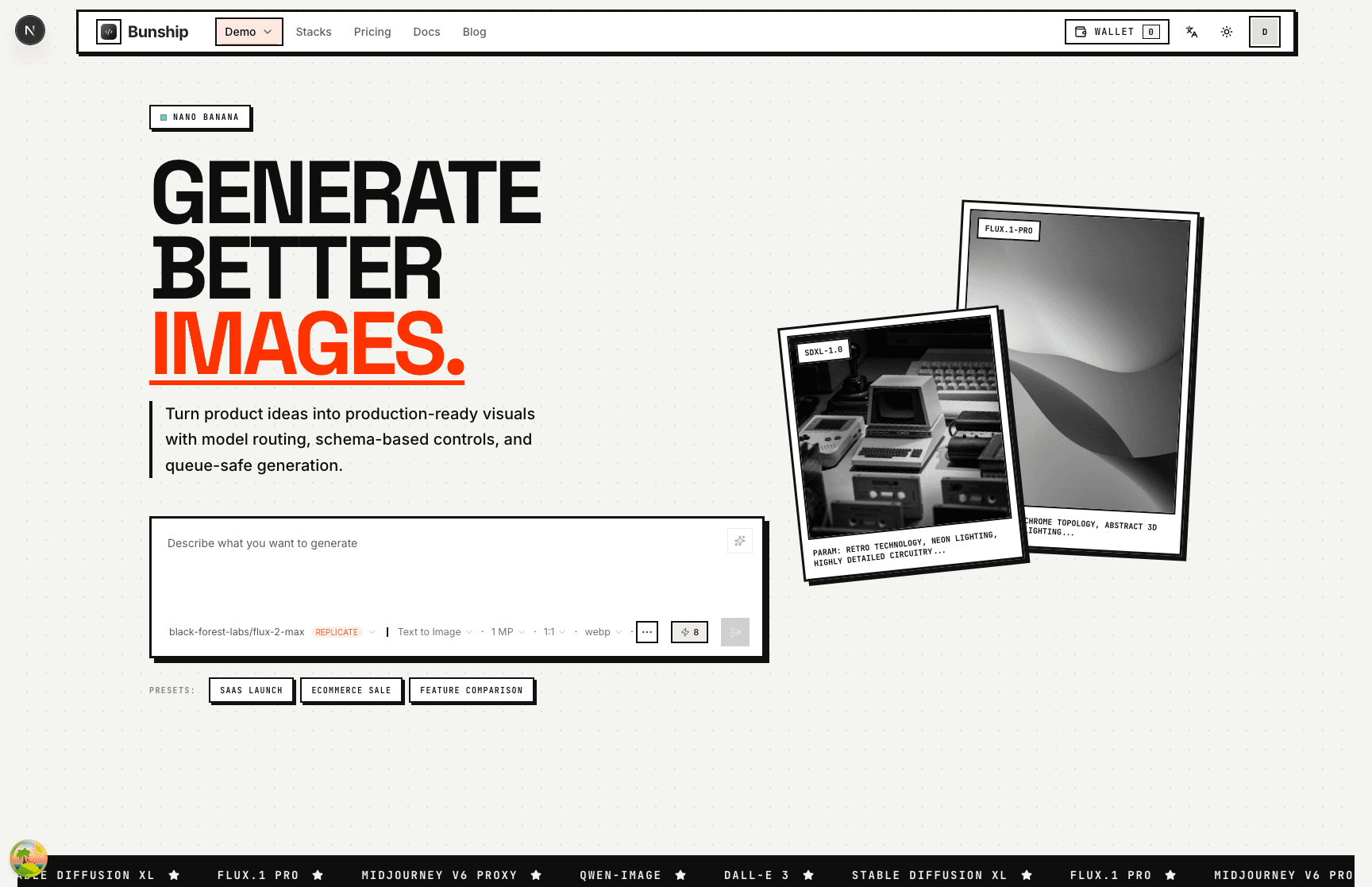
The AI workflow page should demonstrate that BunShip covers more than a prompt form and result gallery.
AI builders need proof that the starter can survive real usage and operator pressure, not just render a single model demo.
Many starter kits stop at provider invocation and leave queue control, billing, and admin handling undefined.
An AI workflow must connect usage, credits, and user-visible history to become a product.
Retries, cancellation, and timeouts should be visible before the buyer opens the codebase.
This page should own the broad AI app intent while queue governance stays as a narrower supporting page.
A live generation workflow already exists and can be adapted to your own AI product domain.
The product story includes model provider configuration instead of assuming one hardcoded vendor.
Credits and pricing logic are part of the workflow rather than a separate afterthought.
This is one of BunShip's clearest differentiators because it connects AI product ambition to operating reality.
Buyers see that BunShip is designed for AI product execution, not just generic SaaS.
The page can answer module-level AI questions cleanly for search engines and answer engines.
Queue, pricing, provider control, and UI output are described as one system.
These links separate the main AI workflow story from its deeper implementation surfaces.
Best for teams choosing a starter because they need AI-native workflows, not just a generic app shell.
Use the existing generation loop as the base for text, image, or other task-driven products.
Ship governed AI task execution without rebuilding admin, billing, and queue surfaces.
Start from a workflow that already explains provider choice, queue handling, and usage economics.
Keep this page focused on the broader workflow so queue-specific questions can be routed cleanly.
Next step
Open pricing if you are evaluating the product commercially or read the workflow docs if you need implementation depth.