 Bunship
AI Providers
Practical AI model and pricing setup: configure models, define pricing rules, and use dynamic parameter-based billing.
This page focuses on three core topics: how to configure models, how pricing is configured, and what dynamic pricing is currently supported.
Admin Configuration Screenshot
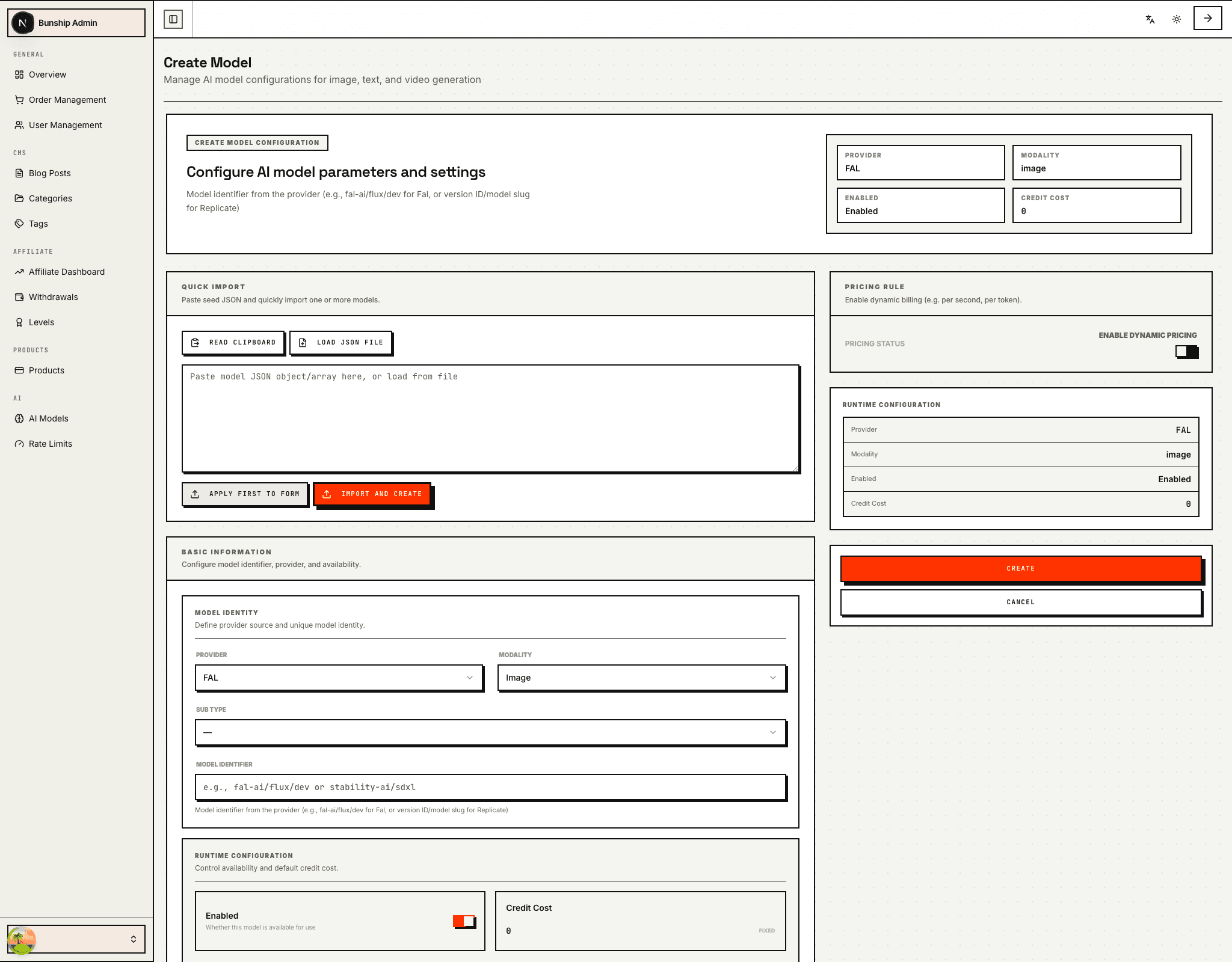
1. How to Configure Models (Fast Path)
In Admin -> AI Models, configure in this order:
- Choose
provider(fal/replicate/kie) - Set
model(for examplefal-ai/flux/dev) - Choose
modality(image/video/audio/text) - Set
enabledand fallbackcreditCost - Define
paramSchema(allowed params + enum options) - Enable
pricingRulewhen you need dynamic billing
2. How Pricing Works (Current Capabilities)
Pricing currently supports two layers:
- Fallback fixed price:
creditCost - Formula pricing:
pricingRule(takes priority when present)
2.1 Fixed Price
Best for initial launch and low complexity.
2.2 Unit-Based Dynamic Pricing
pricingRule.unit currently supports:
image: charged by output countsecond: charged by duration (video/audio)token: charged by text token usage (per 1k tokens)
2.3 Parameter-Based Dynamic Pricing
Yes, this is supported now.
- Define enum params in
paramSchema(for examplequality) - Set per-attribute prices via pricing rule editor
- Or use
tiers.matchto apply conditional price tiers
So both "single-image pricing" and "dynamic pricing by model params" are supported.
3. Practical Pricing Rule Example
{
  "type": "formula",
  "billingMode": "charge_on_complete",
  "unit": "image",
  "price": { "perImage": 10 },
  "tiers": [
    { "match": { "quality": "high" }, "price": { "perImage": 16 } },
    { "match": { "quality": "ultra" }, "price": { "perImage": 24 } }
  ]
}
Meaning: default 10 credits per image, with automatic premium tiers for higher quality options.
4. Key Highlights
- Unified multi-provider management (fal/replicate/kie)
- Fixed + formula pricing can coexist
- Dynamic pricing by parameter enums and tier matching
- Separate estimate and final charge stages
- Price changes are operational, not code changes
5. Recommended Rollout Strategy
- Start with
creditCostfor all models. - Move high-volume/high-cost models to
pricingRule. - Add surcharges for expensive params (quality, duration, outputs).
- Combine rate limits with pricing to cap risk.